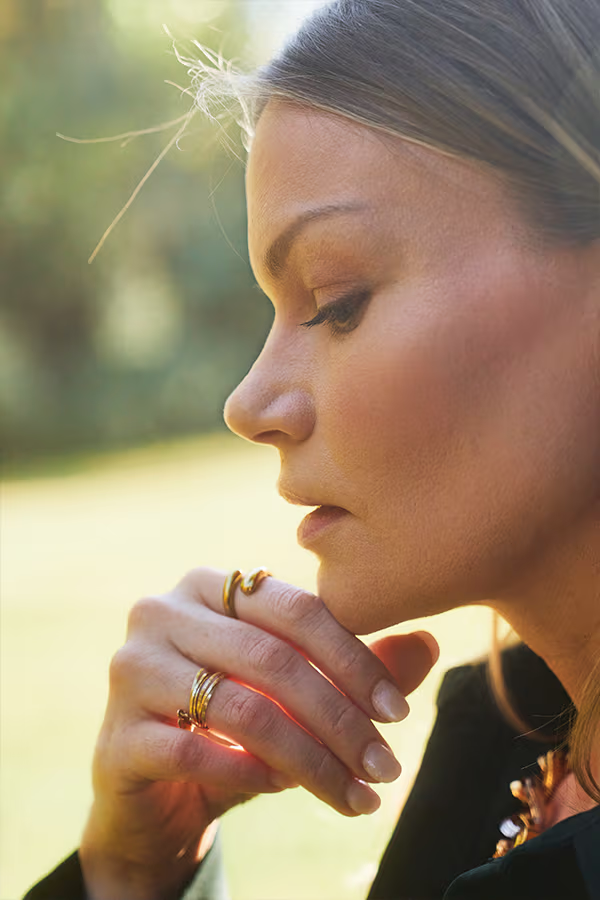
Restore fullness in the parts of the face that move the most, with a filler made to move with them.
Like other hyaluronic acid fillers, RHA restores volume the face has lost, lifting and supporting from beneath the skin. What sets it apart is the gel itself, made to behave more like the tissue around it, stretching as the face moves and recovering as it rests.
That quality matters most in the mid to lower face, where folds form and deepen with constant motion. A filler that moves with the skin holds its correction without stiffening the expression around it. As with all hyaluronic acid, the body breaks it down gradually over time, which is why the result lasts but never settles permanently.

Before anything is decided, your provider watches how your face moves: where a fold deepens when you speak and smile, where fullness has thinned in the parts of the face always in motion. The plan is drawn from what we see. If you bruise easily, set aside alcohol and blood thinners for a few days beforehand, with your doctor's blessing.

The area is numbed for your comfort, then the gel is placed by hand in measured amounts, in the parts of the face that move the most. Your provider asks you to speak and smile as they work, shaping the correction so it sits naturally in motion rather than only at rest.

Expect some swelling, and perhaps a little bruising, as the filler settles over several days, with the final result near two weeks. The areas around the mouth swell a little more, for all their movement. Keep the area clean and free of makeup for the first day, leave it alone, and set aside hard exercise, alcohol, and heat. It should move when you do, and look like no one has touched it at all.


The delicate skin below the eye, where a hollow, a shadow, or a small roll can make the face read tired.
The broad region at the outer brow, where the upper face quietly narrows with the years.
The clean line where the lower face meets the neck, restored along the bone where it has softened.
Lines that draw down from the corners of the mouth, lifted from the structure above.
The anchor of the lower face, treated for both its volume and the muscle beneath it.
The lip and what surrounds it, met with restraint and treated in proportion to the face.
The crease from nose to mouth, met from the support that holds it above.
The architecture of the upper face, restored where time has thinned the support beneath.

RHA is designed for the parts of the face that animate. So we treat them with that motion in mind. We watch your face speak, smile, narrow its eyes, before any decision is made about what to place where.
A fold that softens beautifully at rest can look set in place when the face animates if the wrong filler was used. With RHA, the gel stretches as you do. But the placement still has to follow the motion, not anticipate it.
The work is about supporting expression, not stilling it.
The temptation with motion-resistant filler is to use it more freely, since it reads better in expression. We do not. The restraint that works for any filler works for RHA: less first, more only when the face asks.
A small RHA placement that holds gracefully through motion is the result. A larger one that holds rigidly is not. The product behaves like tissue when used like tissue.
Every face we treat with RHA, we watch first in animation. The lines that deepen when you laugh are not the lines that deepen when you speak, and neither are the lines that deepen when you rest. The hand chooses depth, plane, and amount based on which lines, in which motions, want easing.
The product is built for movement. The hand is what knows where movement lives.
RHA tends to last a little longer than older fillers, twelve to fifteen months for most. So returning visits come a little less often. But the conversation at each one is the same: how has your face changed since we last looked, where does it want a little support, where would less be honest.
We do not maintain a result. We refresh a face that is still your own.
RHA suits the person who has noticed a fold or a loss of fullness in a part of the face that moves a great deal: around the mouth, along the lines that deepen when you speak and smile. Its formulation is designed to move with you, so the correction holds without looking set in place.
It is well suited to those who want restoration that keeps pace with expression, rather than a fullness that only looks right at rest.
RHA restores the fullness that has thinned. For the lines that movement creates on their own, the furrow between the brows or the creases across the forehead, a wrinkle relaxer is the right answer, and we would be glad to walk you through that path at the consultation.
What we work toward here is restoration in keeping with the face you already carry. If what you are hoping for is a face changed rather than rebuilt, you will likely find a better fit at a different practice, and we would say so kindly, before any work is begun.
RHA is priced by the syringe. How many syringes you need is decided by your face, not a package. We will tell you the cost before anything begins, and the final plan is settled at your consultation.
Yes. Like all hyaluronic acid fillers, RHA can be dissolved with hyaluronidase should the result ever need correcting. We rarely need it, but the option matters.
That is precisely what it is built for. The gel is designed to move with you rather than resist motion. In a face that animates a great deal, RHA tends to look more natural in expression than a stiffer filler would.
For most patients, twelve to fifteen months. The exact length depends on the product within the RHA family and the area treated. Areas that move more break the gel down faster than areas that stay still.
RHA, short for resilient hyaluronic acid, is formulated to behave more like living tissue. The gel stretches as the face moves and recovers as it rests, so it tends to sit more naturally in expressive parts of the face. Where a fold lives in an area that is always in motion, RHA often holds its correction without stiffening the expression around it.