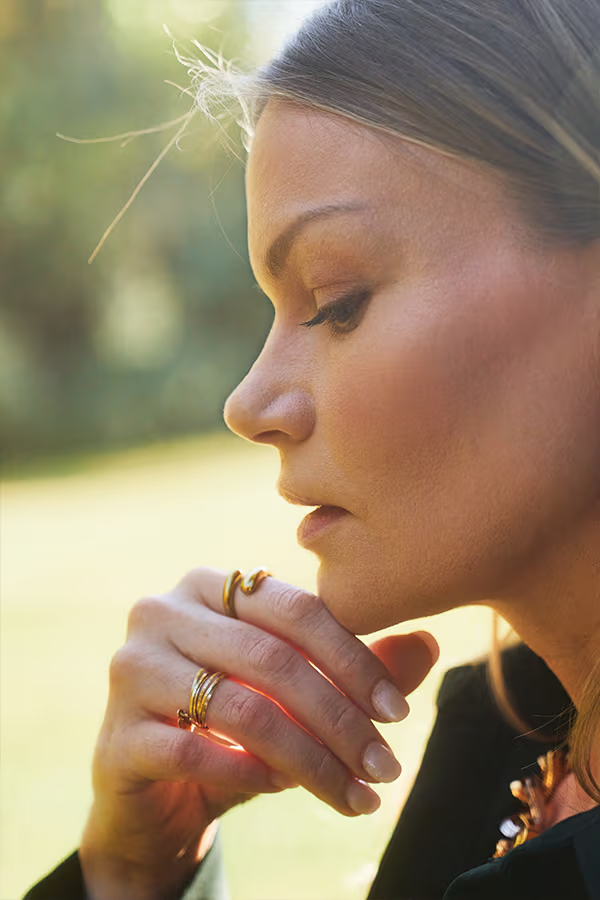
Restore the fullness and contour that the years quietly carry off, with the most established family of fillers.
With age the face loses volume, not only fat and bone but the hyaluronic acid that once kept the skin full and resilient. As that support recedes, the cheeks flatten, folds deepen, and the lower face begins to draw downward.
Juvederm restores that lost support directly. The gel is placed in measured amounts at a chosen depth, where it lifts and fills, and where the hyaluronic acid continues to draw water to itself, holding the correction softly in place. The face is supported from beneath rather than altered at the surface. In time the body breaks the gel down on its own, gradually and harmlessly, which is why the result is lasting but never permanent.

Before anything is decided, your provider studies the face: where fullness has shifted, where support has softened, where a fold has deepened, and how the whole face sits in balance. The plan is drawn from what we see, read by anatomy and proportion rather than a chart. If you bruise easily, you may set aside alcohol and blood thinners for a few days beforehand, with your doctor’s blessing.

Most fillers carry a numbing agent of their own, and a topical cream is sometimes added for comfort. The gel is then placed by hand, in small, measured amounts, at the chosen depth. Your provider works gradually, shaping as they go and asking you to sit up and look as the work proceeds. Most of an appointment is reading and assessment, not the placing itself.

Expect some swelling, and perhaps a little bruising, as the filler settles over several days. The lips, being delicate, ask for more patience than other areas. Keep the area clean and free of makeup for the first day, leave it alone, and set aside hard exercise, alcohol, and heat. The result shows at once, but give it the full two weeks before you judge it, and a little longer before deciding whether anything more is wanted.


The delicate skin below the eye, where a hollow, a shadow, or a small roll can make the face read tired.
The broad region at the outer brow, where the upper face quietly narrows with the years.
The clean line where the lower face meets the neck, restored along the bone where it has softened.
Lines that draw down from the corners of the mouth, lifted from the structure above.
The anchor of the lower face, treated for both its volume and the muscle beneath it.
The lip and what surrounds it, met with restraint and treated in proportion to the face.
The crease from nose to mouth, met from the support that holds it above.
The architecture of the upper face, restored where time has thinned the support beneath.

Juvederm restores fullness that has gone. It does its best work where time has taken something, not where the face is still as it was. So before a single syringe is opened, we watch how your face has settled with age: where the cheek has flattened, where the fold has deepened for want of support beneath.
The work follows what time has taken, gently and gradually. We place small amounts, and we ask you to wait at least two weeks before any more is considered, so the treatment can settle before we decide whether the face wants anything further. A face built across more than one visit looks more like itself than a face built in one.
We refine gradually rather than overcorrect. A carefully placed syringe shows where the face benefits from support and where it does not, and how each area settles before more is considered. Anything further, when needed, is best placed on a calm, unswollen face than a freshly treated one, so each visit builds on a true reading of the last.
Filler is placed in layers the camera cannot see. A skilled hand knows when the resistance changes, when the needle has reached bone, when the gel is sitting where it was meant to sit and not floating above it.
This is the part of the work that does not show in before-and-afters. The patient sees the smoothness of the cheek; the provider feels every layer beneath that produced it.
The hand is what makes filler look like restoration, rather than addition.
Hyaluronic acid filler softens over time, gradually, and so do you. We do not top up to the level of the first visit. We assess what the face is asking for now, which is usually somewhat different from what it was asking a year ago.
The plan grows quieter with the years. A maintenance visit often uses less, not more, because what remains is doing its work, and only a small refinement is needed to keep the face looking like itself.
You are not chasing a year-ago version of yourself. You are tending the face you have today.
Juvederm suits the person who has begun to notice not new lines but a loss of fullness: a cheek that has flattened, a fold that has deepened, lips that have thinned, a face that looks a little tired even when it is not. It restores what time has quietly taken, and it does so gradually, by degree, never all at once.
It is well suited to those who would rather rebuild their own contours than change them, and who understand that the most natural result is built in small amounts, often across more than one visit.
Juvederm restores what has thinned. For the lines that movement creates, the furrow between the brows or the creases across the forehead, a wrinkle relaxer is the right answer, and we would be glad to walk you through that path at the consultation.
What we work toward here is restoration in keeping with the face you already carry, not a face changed beyond its own proportion. If a dramatic transformation is what you are hoping for, you will likely find a better fit at a different practice, and we would say so kindly, before any work is begun.
It depends on the area and how much volume has been lost. A subtle lip enhancement might use a single syringe; a fuller midface restoration may use two or three across a couple of visits. We will give you a clear estimate at consultation, and never push more than your face actually calls for.
The needles are fine, and most Juvederm products contain lidocaine, a numbing agent built into the gel itself. The first injection has a small pinch, and after that the area is generally comfortable. Topical numbing is available beforehand if you prefer.
Yes. Because Juvederm is hyaluronic acid, it can be dissolved with an enzyme called hyaluronidase. This is one of the reasons we favor hyaluronic acid fillers. Should the result need correcting, it can be.
In our hands, yes. We place small amounts at a time, often across more than one visit, and judge the work by the face in front of us rather than a chart. The aim is restoration. You look like yourself, just rested. If what you want is a face visibly altered, we are likely not the practice for you.
Most Juvederm products last between six and eighteen months, depending on the formulation and the area treated. Areas that move more, like the lips, tend to break the gel down faster. Areas like the cheeks, where there is less motion, can hold significantly longer.